BusinessWire
Former minister arrested in Paraguay’s latest Ueno Bank failure fallout
A former economy minister has been detained, accused of financial crimes linked to Paraguay's collapsed Ueno Bank.
Nairobi, Kenya
Morocco is launching a new effort to restore its threatened argan forests, with the foundation of Al Mada, the investment holding company controlled by King Mohammed VI, committing to fund the planting and regeneration of 1,000 hectares (2…
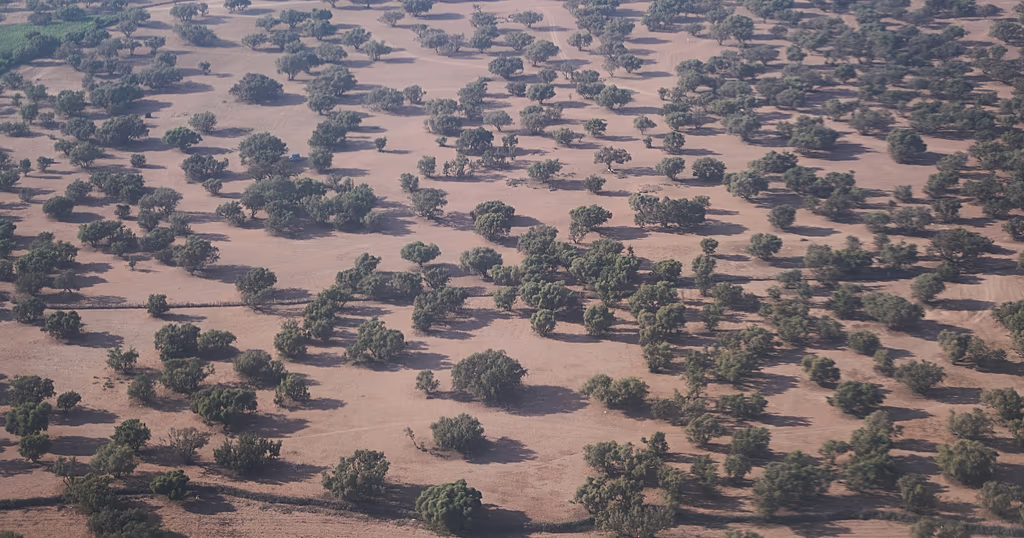
Morocco is launching a new effort to restore its threatened argan forests, with the foundation of Al Mada, the investment holding company controlled by King Mohammed VI, committing to fund the planting and regeneration of 1,000 hectares (2,471 acres) of argan trees in the southern Souss-Massa region. Morocco is launching a major initiative to restore 1,000 hectares of argan forests in the Souss-Massa region.
The project aims to strengthen the ecosystem against drought and climate change, protecting both natural resources and rural livelihoods tied to the argan industry. A standout feature of the effort is the Waterbox system, an innovative technology that conserves water and boosts young argan trees’ survival in dry conditions.
Read also Former minister arrested in Paraguay’s latest Ueno Bank failure fallout
The argan tree, crucial for biodiversity and soil protection, also sustains rural Moroccan communities, particularly women involved in argan oil production. The project will be implemented through a partnership with Morocco ’s National Agency for Water and Forests (ANEF), which will provide the technical expertise and local support needed to carry out the programme.
Beyond expanding the country's argan forests, the initiative is designed to protect an increasingly vulnerable ecosystem from drought and climate change while preserving the natural resources and rural livelihoods supported by the argan industry. Fighting drought with technology Under the agreement, Al Mada Foundation will provide the funding, while ANEF will contribute its technical expertise and local knowledge to implement the programme.
One of its key features is the introduction of the Waterbox system, an ecological technology designed to help trees survive in arid environments with limited water resources. The device collects rainwater, dew and moisture from condensation, gradually releasing the water around the roots while limiting evaporation.
The approach is expected to improve the survival and growth of young argan trees while reducing their water requirements. Protecting a valuable Moroccan industry The argan tree is native to Morocco and plays an important role in preventing desertification, protecting soil and preserving biodiversity.
Its forests also support an important rural economy, particularly through traditional argan oil production, which provides income for many women. However, the growing global demand for the oil, often described as 'liquid gold', is adding to the pressures on an already fragile ecosystem.
Once covering more than 14,000 square kilometres, Morocco's argan forests have lost nearly 40% of their area in recent decades, with recurring droughts and climate change further threatening their survival. The industry also faces concerns over sustainability and the distribution of its economic benefits.
Read also Equity Group Partners with Japanese Bank to Link Local Firms to Asian Markets
In 2025, some cooperatives raised concerns that harvesting argan fruits before the proper season could damage the trees and compromise oil quality. Workers also say they receive little of the profits from an international market where argan oil prices have surged from about $2.
50 to $60 per litre over the past three decades. Morocco's argan trade has also faced setbacks in international markets.
Exports are projected to reach around 526 tonnes in 2025, down from more than 1,500 tonnes in 2019. Against this backdrop, the new restoration programme is aimed at reversing the decline of the argan ecosystem, protecting a globally recognised natural resource and sustaining the rural communities whose livelihoods depend on it.
This report was written and published by Business Insider Africa, not by the Kenya Business News newsroom. It is republished here in full with credit to the publisher, and the headline remains the copyright of Business Insider Africa. Read our attribution policy. Photographs are the publisher's and are credited above. Last updated 25 November 2026.
A former economy minister has been detained, accused of financial crimes linked to Paraguay's collapsed Ueno Bank.
Equity Group has partnered with Japan’s MUFG Bank to establish a Japan and East Asia Desk, connecting businesses across East and Central Africa with Asian markets. This initiative will facilitate cross-border trade, investment and market e…
A convoy of three Russian ships carrying military vehicles to Libya has reversed course in the Mediterranean following a Ukrainian drone attack that sank a Russian naval corvette at Benghazi port, raising questions about Moscow’s military…